Watch Full Community Meeting Here:
Audio Here:
https://ice9.securenetsystems.net/media/KCSI/ondemand/HCPROJECT-Heartland_Corridor.m4a?1785293026014
RED OAK — Farmers Mutual Telephone Company is evaluating a community-scale digital infrastructure project that could bring a locally owned micro data center to Red Oak while generating revenue for broader economic development efforts across southwest Iowa.
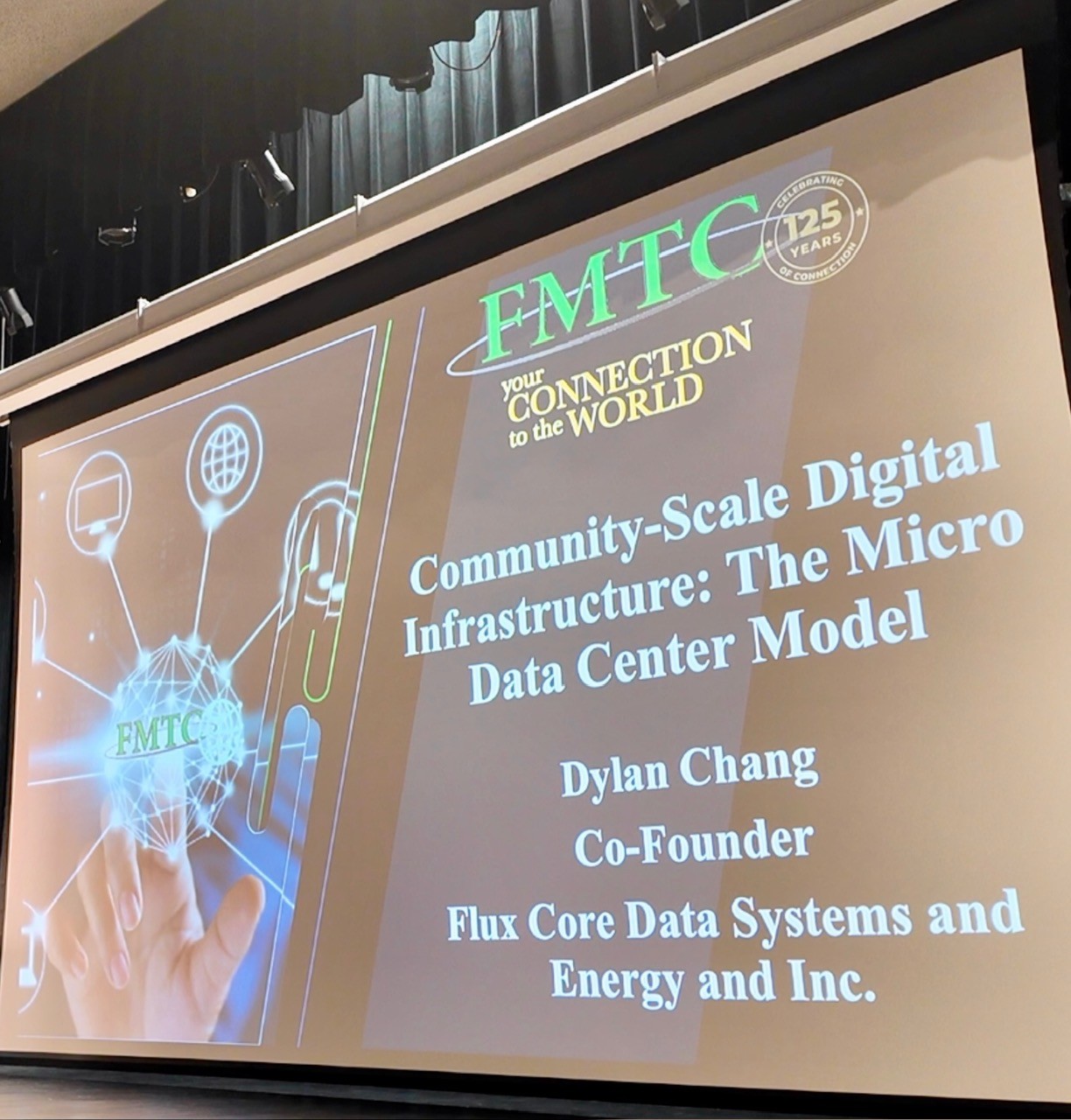
FMTC hosted an informational meeting Tuesday, July 28, at the Red Oak High School Auditorium to explain the proposal, answer questions and distinguish the project from the large hyperscale data centers drawing scrutiny in Iowa and across the country. Company officials emphasized that the gathering was educational and that no final project approval or construction commitment has been made.
Presenters included Kevin Cabbage, chief executive officer of FMTC; Christopher P. Hughes, Ed.D., Major General, United States Army retired, and chief executive officer of The Way Forward; and Dylan Chang, co-founder of Flux Core Data Systems and Energy, Inc. The public discussion was moderated by Ron Kloewer, rural development manager for the Heartland Community Investment Group.
Cabbage said three regional telecommunications companies have signed a letter of intent and a term sheet describing how a new partnership would operate. A final operating agreement remains under review and would need approval from each company’s board of directors.
While Cabbage said the parties believe the project is close to moving forward, he stressed that it is not yet a completed agreement and cannot be formally announced as a finalized development.
The proposed site is FMTC-owned property near the corner of Fourth and Linden streets in Red Oak. FMTC already operates a telecommunications central office building on the property, which is connected to the company’s redundant fiber-optic network.
The initial development would include one container housing graphics processing units, or GPUs, a second container containing cooling equipment and space for two natural-gas generators. The site could eventually accommodate as many as three micro data center containers, although officials said the first unit would need to be built, placed into service and financially proven before expansion decisions are considered.
Chang described the proposed facility as a micro edge data center designed to provide computing capacity for artificial intelligence, digital rendering, research and other high-performance applications. Instead of a company purchasing computing capacity through a long-term contract with a major cloud provider, customers could purchase access to the GPUs by the hour, day, month or another period through computing-capacity brokers.
Flux Core would manufacture, install, operate and maintain the facility under contract, while the new regional partnership would own the equipment. Chang said software would monitor market demand and direct the computing capacity toward available customers and workloads.
The initial container is expected to contain approximately 360 GPUs. Chang said the equipment would be refreshed approximately every three years to maintain competitive computing capability.
Project representatives repeatedly distinguished the proposed facility from a hyperscale data center. Hyperscale facilities can occupy hundreds or thousands of acres and require extensive utility infrastructure, while the Red Oak proposal would use a comparatively small footprint on property FMTC already owns.
The proposed cooling system would use a closed loop containing approximately 700 gallons of deionized water. Chang said the system would be filled once, continuously recirculate the water and be designed to operate for approximately 10 years without requiring replacement water.
The facility would be powered by natural-gas generators rather than drawing its primary power from the local electrical grid. Chang said the behind-the-meter design is intended to avoid requiring major electrical-grid upgrades or placing additional demand on existing community infrastructure.
He said the generators would be enclosed and designed to remain below 60 decibels at approximately seven meters. A block wall would also be used to direct sound upward and reduce the impact on nearby residences.
Cabbage said the facility would be located within Red Oak, connect to city utilities and pay applicable local taxes like other businesses. He also said the proposed partnership would not include an outside equity investor. The three participating telecommunications companies would finance and own the project, although borrowing would be required.
During the meeting, representatives said the project would be privately financed and would not rely on federal subsidies. Federal tax credits or carbon-related credits could still apply to certain equipment or energy components.
One of the central features of the proposal is a commitment to direct 10% of the project’s net revenue, before distributions to the ownership partners, to the Heartland Community Investment Group.
The regional group would use the money to support infrastructure, education, workforce training, community projects and business development. Officials said funding decisions would be made with input from participating communities rather than being limited to Red Oak.
Cabbage declined to offer a projected dollar amount for the 10% contribution, saying the numbers would remain estimates until the facility is operational and producing actual revenue.
Hughes said the investment group is intended to provide a dependable method of returning part of the project’s proceeds to southwest Iowa. Potential uses could include scholarships, workforce upskilling, grants or loans for municipalities, infrastructure improvements and efforts to attract additional companies to the region.
The initial data center itself would not create a large number of permanent operating jobs. Chang said the unit is designed to operate autonomously, with remote monitoring and limited on-site security and maintenance requirements.
Project representatives said the larger employment opportunity could come through future manufacturing. Flux Core has discussed the possibility of working with existing manufacturers to produce containers, cooling systems, tanks, battery storage equipment and related components.
Chang said a fully developed manufacturing operation could require approximately 160 to 200 employees, but he and other speakers made clear that manufacturing would be a later phase and is not part of the initial data center commitment.
Kloewer, the former chief executive officer of Montgomery County Memorial Hospital, said his role with the Heartland Community Investment Group will include helping turn the project’s economic-development concepts into practical programs.
He said southwest Iowa communities must find new ways to counter population decline, broaden their economic base and reduce the pressure placed on schools, hospitals and local governments supported by a shrinking number of taxpayers.
Cabbage said the proposal reflects FMTC’s long-standing mission of investing in infrastructure that connects rural communities. The company began with telephone service more than 125 years ago and later expanded into cellular, broadband and fiber-optic infrastructure.
He described the potential micro data center as another step in that progression, allowing locally owned companies to participate in the growing market for digital computing infrastructure.
FMTC said it will continue evaluating the technical, operational, financial and community implications of the project. Final details involving the partnership, ownership, construction and development plans would be announced only after the necessary agreements and board approvals are completed.